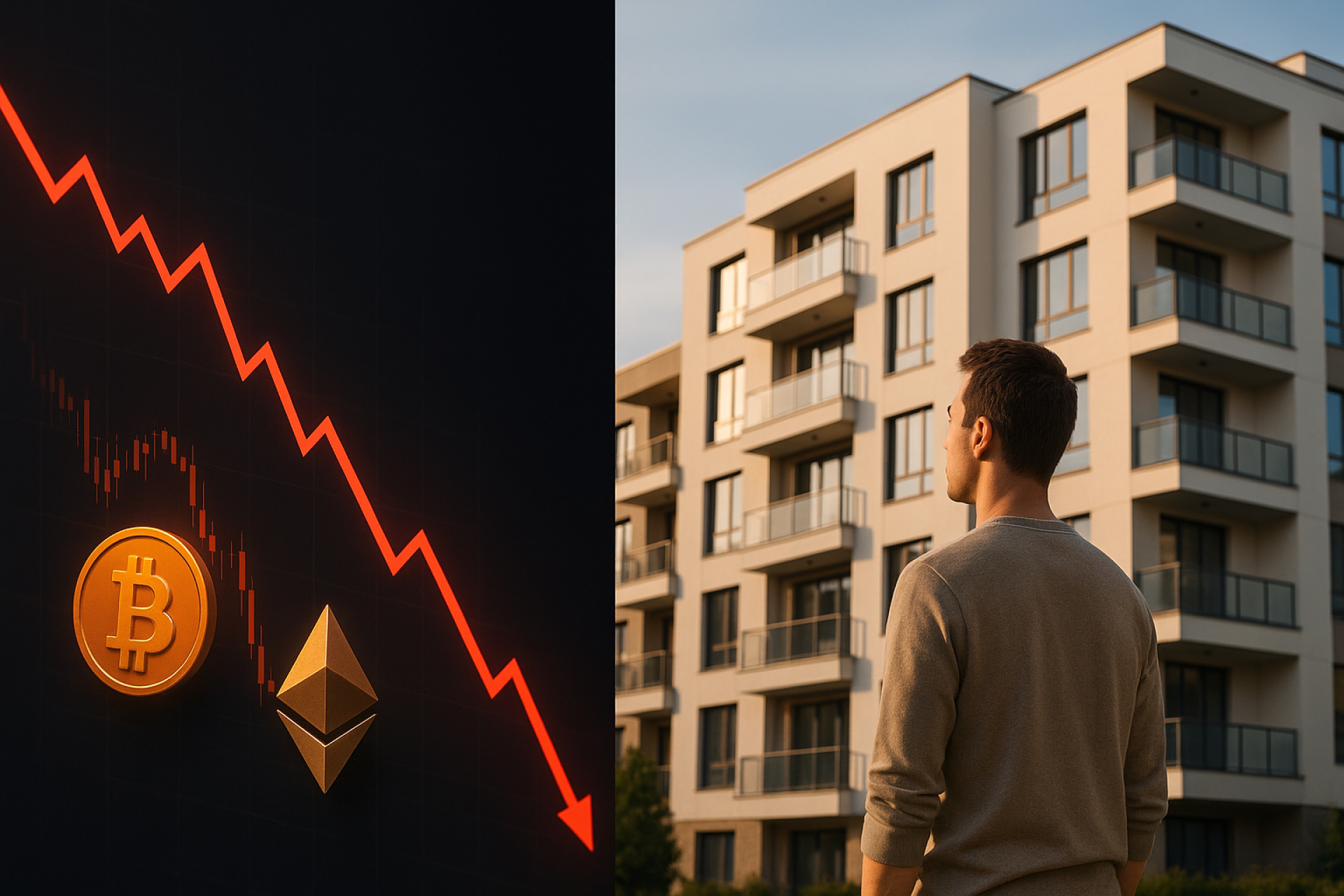
In recent years, many Bulgarian investors have boldly entered the world of cryptocurrencies. The quick profits created a feeling that “old” assets like housing are boring and outdated. But every serious crash in the crypto market reminds us of a simple truth – a home and a roof over your head have a value that does not depend on the tweet of an influential investor or the latest tech meme.
When the charts turn red, the logical question is: is it time to transfer some of my capital into real estate, and more specifically, into housing? The answer is rarely “all or nothing.” In most cases, the sensible step is diversification – spreading risk across different asset classes so that no one of them “pulls” your entire wealth down.
After a major cryptocurrency drop, there are two extremes. Some investors panic sell at the bottom and lock in their losses. Others are stubborn and refuse to realize that their strategy needs to change. The more mature approach is to do an honest analysis: how much of your portfolio is in highly volatile assets and how many years in the future you can realistically wait for a possible recovery. If the answer is “I don’t know” or “I don’t have the nerve for another -50%”, this is a clear signal to consider reorienting to more stable assets.
Residential properties are a typical example of such a stabilizing asset. They are not completely risk-free – prices can also adjust, there can be periods without tenants and unexpected expenses. But they are a real, tangible asset that brings benefits even in the most difficult times. Someone will always need a place to live, and a well-chosen home in a city like Sofia, Plovdiv, Varna or Burgas rarely remains empty for long.
When is the logical time to diversify? Often it comes not at the absolute bottom of the crypto market, but when you realize that the risk no longer allows you to sleep peacefully. If you follow the news with a racing pulse and check your app every ten minutes, then your exposure to volatile assets is excessive. Then you can set a simple threshold - for example, fix a target for a partial exit when a cryptocurrency recovers a certain level. This way, you are not chasing the “perfect peak”, but providing yourself with funds for safer investments.
The next step is to decide what proportion of your total wealth should be in housing. For some people, this is a first home – security for the family, a fixed expense instead of constantly rising rent, and a sense of “anchorage” in unstable times. For others, the idea is an investment property – a small apartment in an area with good transport connections, universities, office buildings or hospitals, where rental demand is stable over the years.
It is important not to approach real estate emotionally. The same mistakes that are made in crypto – chasing “hot” projects, fear of missing out, excessive risk – can be repeated in housing. The market in some neighborhoods is already overheated, while others are just developing. Therefore, it is wise to work with a consultant who knows the local peculiarities, real rent levels and infrastructure development plans.
A pragmatic strategy is to phase in capital transfers. Instead of selling your entire crypto position at once, you can plan for several waves – for example, during each major recovery, convert some of the profits into more stable assets. This reduces the risk of “hitting” the most unfavorable moment and gradually builds a property portfolio that balances the volatility of digital assets.
Don't underestimate leverage. With cryptocurrencies, borrowed capital is extremely risky because liquidations can be brutally fast. With housing, a mortgage, if carefully structured and tailored to your income, can work to your advantage. Part of the capital released from crypto can serve as a deductible, and the rest can remain in more liquid reserves. This way, you take advantage of the property market without completely depriving yourself of the opportunity to participate in future rises in other assets.
Don’t forget the investment horizon. While we think in terms of days and weeks with cryptocurrencies, quality housing is considered over a period of at least one full economic cycle – about ten years. During that period, you have time to go through minor repairs, optimize maintenance costs, increase energy efficiency, and thus raise both the market value and the attractiveness of the property for tenants. This slower, “marathon” approach is often not as exciting, but it is precisely what distinguishes the successful long-term investor from the one who is always chasing the next fast trend.
Ultimately, the goal is not to choose the “right camp” – crypto vs. real estate. Both directions have their place in the modern portfolio. The difference is that housing is an asset that brings peace of mind, predictability and real benefit in everyday life, while cryptocurrencies are closer to a risky but potentially high-yield innovation. When the balance between the two is reasonable, crashes in one segment no longer feel like a personal catastrophe, but as a natural part of the investment cycle.
If the crypto market has painfully reminded you that nothing grows forever, it might be time to look at bricks and mortar not as a “boring alternative” but as smart insurance. A well-chosen residential investment doesn’t promise get-rich-quick, but it does promise something more valuable – stability, the opportunity for passive income, and the confidence that the next crash won’t catch you without a plan.

Register for free to be the first to hear the news on imi.bg
Register